|
All Birch & Willow lamps and luminaries are designed to use medium
light bulbs, with the exception of the Twinkle pendant, which uses candelabra bulbs. There is a label on each lamp or luminary indicating the
recommended maximum wattage. The recommended maximum wattage is based
on the Underwriter Laboratory Guidelines.
Technological advances in lighting are producing better and better energy efficient options to incandescent bulbs. Household applications for LEDs are still limited. Compact fluorescent bulbs (CFL) are suitable for more and more uses. We still recommend the use of incandescent bulbs to create the most wonderful sparkles and shadows. We will keep you posted on advances of CFLs.
A wide variety of incandescent
light bulbs are available. Light bulb characteristics include shape,
color, warmth or coolness, surface quality as well as standard
or energy efficiency. The type of light bulb
used will effect the color of the paper and influence the quality of
the shadows generated by the lamp or luminary.
We hope that our quick reference page provides enough information for you to learn about
the possibilities of creating the most beautiful light and shadows with
your Birch & Willow lamp or luminary. We also hope it will help you choose the most suitable lamp or luminary for your lighting needs. Please contact us if your question is not addressed.


How do we determine the maximum wattage for a lamp or luminary?
There are two factors:
1) By UL Guidelines, the maximum recommended wattage for a table or floor lamp with a lamp shade is primarily a function of three things: the top opening, bottom opening, and slope of the lamp shade. See illustrations.
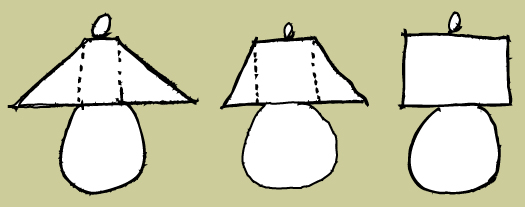 |
Wide Shade
smallest space, lowest wattage
60 watts |
Empire Shade
medium wattage
75 watts |
Drum shade
largest space, highest wattage
100 watts |
The greater, or more acute, the slope of the shade, the lower the maximum wattage. A lampshade with a smaller slope or straighter sides can accommodate a higher wattage bulb.
2) We consider the effect of higher and lower wattage bulbs.
For example, the distance between the light bulb and the side of the shade or lamp may be great enough to accommodate a 100 watt bulb. However, this high-wattage bulb may be too bright for that particular lampshade, creating "spotting."
Ideally, the lamp shade diffuses the light source evenly. If the bulb is very bright, it will create a "hot spot" or spotting.
When lamping our woven lamps and luminaries, we want to create a sparkling effect of light filtering through the vines. Therefore, the maximum bulb wattage is based on a balance of bulbs that will be as bright as possible without creating glare.
↑top

Does the color of the light bulb matter?
The color of your light bulb has an impact on the quality of light emitted from your lamp or luminary. The most commonly used light bulbs at Birch & Willow are Soft White, Pink, and Full-Spectrum (daylight corrected) incandescent bulbs, and compact fluorescent bulbs. Each produces its own quality of light.
The four photos below are all of the same Cocoon sconce, but each photo was taken with a different kind of bulb. Notice how the look of the paper and cast of the light differs with each bulb selection.
Click an image to enlarge it.
Medium Diagonal Cocoon with paper #311.
↑top

How do different types of bulbs effect my Birch & Willow woven lamp or luminary?
We recommend clear and iridescent bulbs for all woven Birch & Willow sconces and pendants. Iridescent bulbs are available up to 60 watts only.
The photos below are all of the same Roost pendent. Each photo was taken with a different type of 100W bulb. Notice how the look or sparkle of the light varies with each bulb selection. Even more noticeable is the effect of the bulb type on shadows.
Click an image to enlarge it.
↑top

Do you use Compact Fluorescent bulbs in lamps and luminaries?
Yes. We encourage our customers to use compact fluorescent (CFL) light bulbs over incandescent bulbs whenever possible. They are more energy efficient than incandescent bulbs, and have a considerably longer life of 8,000 - 10,000 hours. CFL bulbs now even come in a range of colors from 2800K - 5000K, and are even available as high as 6500K. Three-way and dimmable (25W and up) CFL bulbs are also available.
The quality of light generated by CFL bulbs is considerably different than the quality of light emitted by incandescent bulbs (see section "Bulb Color" above). We recommend incandescent bulbs in applications where sparkle is particularly important, as it is in all of Birch & Willow's woven lamps and luminaries.
Below you will find a conversion chart of CPL bulbs and their incandescent equivalents.
| Incandescent Equivalents |
| CFL |
|
Incand. |
| 3W |
= |
15W |
| 5W |
= |
25W |
| 7W |
= |
35W |
| 9W |
= |
40W |
| 11W |
= |
50W |
| 13W |
= |
60W |
| 15W |
= |
70W |
| 20W |
= |
75W |
| 25W |
= |
100W |
| 30W |
= |
135W |
| 35W |
= |
150W |
We recommend compact fluorescent bulbs specifically for the Pod Pendant, Bower Sconce and any of our table lamps and floor lamps which have shades.
↑top

How do I dispose of CFL bulbs? Don't the bulbs contain mercury?
Compact florescent bulbs are not to be put into the trash with your everyday garbage. CFL bulbs contain small amounts of mercury (about 4.0 milligrams) and, while posing no immediate health threat if broken, require special disposal at your local recycle center or local waste management to avoid mercury buildup in landfills. It is a concern for landfills and waste incinerators where the mercury from lamps may be released and contribute to air and water pollution.
Please encourage retailers who sell CFLs to recycle them (Ikea) and encourage take-back programs similar to those being instituted for other electronics. Also seek out lower-mercury bulbs. Philips has introduced its ALTO line of CFLs and fluorescent tubes. This line of CFL bulbs have 70 percent less mercury than fluorescent bulbs manufactured in 2001. GE also manufactures CFL bulbs with very low mercury content CFLs.
Safe disposal requires storing the bulbs unbroken until they can be processed. The next step is to seek advice from local authorities. In most cases you will be directed to:
1. Return used CFLs to place of purchase, so the store can recycle them correctly;
2. Osram Sylvania sponsors a CFL recycling program through its retailers;
3. Take used CFLs to a local recycling facility; or
4. Check out these national resources for disposal and recycling information:
www.lampcycle.org
www.earth911.org
800-CLEAN-UP
The Boston Globe reported, on July 14, 2008, Brown University engineer Robert Hurt and colleagues, "...discovered a nanomaterial that operates like a sponge to absorb mercury from a broken CFL.
The researchers, who have applied for patents, hope to see the cloth packed in with the lights when they are sold. That way, they can absorb mercury if the fragile lights break in the packaging."
So, the possibilities of energy efficient and environmentally safe light bulbs continues to improve.
↑top

Will my Birch & Willow lamp or luminary come with light bulbs?
Due to the expanding light bulb options, Birch & Willow no longer includes light bulbs with the fixtures unless speicified in the order or the order calls for GU-24 bulbs.
In all cases, it is important to specify the type of bulbs you plan to use and the wattage requirements when you are placing your order.
Where can I find replacement bulbs for my lamp or luminary?
Replacement light bulbs are readily available at local hardware or lighting stores, unless otherwise specified. GU-24 bulbs can be purchased through Birch & Willow.
↑top

What do you mean by warm/cool light bulbs?
Light bulbs in a wide range of color temperatures are readily available. Please see the chart below for an idea of what quality of light different temperature bulbs emit. The higher the temperature of the bulb, the cooler the quality of light.
| Warm White |
= |
2800K |
| Soft White |
= |
3000K |
| Cool White |
= |
4100K |
| Daylight |
= |
6500K |
↑top |





























































)
)
)
)
)
)
)
)
)